media & Irrigation Blog
Subsurface Drainage
2024/07/26 : LinkedIn : Subsurface Drainage
The importance of subsurface drainage in your orchards
The importance of subsurface drainage.
Proper orchard planning before planting is critical for your irrigation management early in the season, as well as during the season.
Soil surveys before orchard establishment allow growers to:
◾ Choose the correct row direction for surface drainage (and light interception); plan sufficient subsurface drainage in wetter areas; execute soil preparation to remove compaction; and build ridges where required.
◾ All these practices go a long way in ensuring a more uniform orchard, and easier irrigation scheduling during the season.
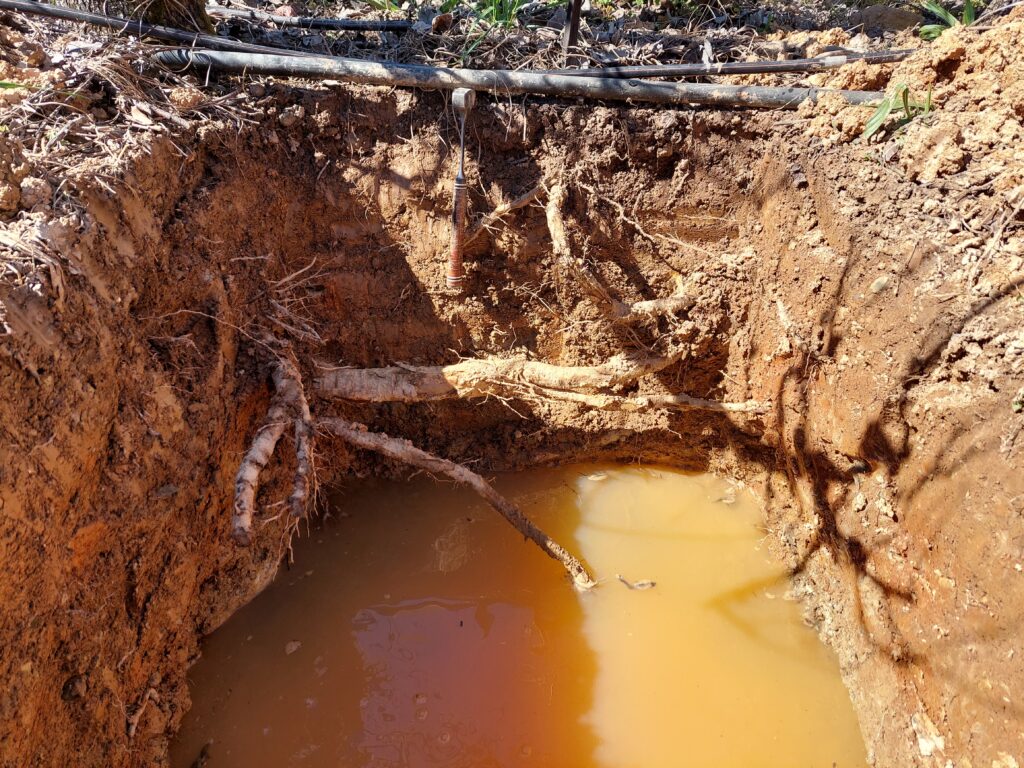
In a wet winter, water tables build up in parts of orchards.
◾ In the drier periods, these areas are identified by mottling observed in soil profile holes.
◾ Subsurface drainage will remove excess water, increase oxygen content, and increase soil temperatures.
◾ Optimising these factors are critical for improving root systems and nutrient uptake.
The result of a water table which has not been rectified, is an area within an orchard with a shallow and unhealthy root system.
◾ This is due to the lack of oxygen lower in the soil profile which inhibits root development and promotes root rot such as Phytophthora.
◾ Once the water table disappears later in the season, this area in the orchard is very prone to water stress due to the shallow root system.
◾ In comparison to other parts of the orchard with deeper root systems (which require longer irrigations), these areas will require shorter more frequent irrigations due to their shallower root systems. Longer irrigations in these areas will result in saturation of the subsoil again.
◾ To optimally irrigate these zones of different root depths, the grower is left with two options. Install subsurface drainage to correct the issue over time and increase root depth; or add extra valves and manage the irrigation of these areas separately. Both are expensive procedures which can be avoided with proper initial orchard planning.
Another reason for installing subsurface drainage can be in dry soils, but where there are brak issues and leaching is required.
◾ In this scenario the subsurface drains will be used as a transport system to remove salts from the orchard.
Subsurface drainage is also installed on the uphill side of roads.
◾ During the irrigation season, water can often accumulate at the bottom of rows, especially where over irrigation is taking place.
◾ Drains will remove excess water (and leached expensive fertiliser); improve the soil oxygen content; and increase soil temperatures, resulting in a more uniform orchard. (They should however not be installed to compensate for over irrigation!)
We all want uniform orchards to make our orchard management practices and irrigation scheduling as easy as possible.
These topics are typically addressed on irrigation farm visits where profile holes are dug; soil and roots are inspected and problem solving is done.
When in doubt, dig a hole.