
Irrigation Training Courses
Invest in your team and see the fruits in your orchards
OBJECTIVE : Increase a farm’s water use efficiency, their ability to develop irrigation strategies & effectively use irrigation scheduling tools.

Irrigation training courses adapted for your needs
About our Irrigation Training.
- Irrigation training courses focus on irrigation scheduling in the fruit industry with a strong focus on soil hydraulic properties, horticultural practices and practical irrigation scheduling techniques.
- Courses can be arranged for a farm’s team, for a group of your clients, or offered as a course for which individuals can sign up.
- Courses take place at a venue of your choice.
- Theoretical training typically takes 4 to 5 hours.
- An optional practical session in the afternoon is highly recommended. There we look at soil profile holes and root development, and learn how to evaluate soil moisture and probe positions.
- The level of theory is adapted to the group’s needs but is generally aimed at middle to top management.
- MuddyBoots Irrigation training books are supplied to each attendee in either English or Afrikaans.
- Slides are presented in English, with Afrikaans explanations when required.
- Question can be asked and answered in either English or Afrikaans.
- An certificate of attendance is supplied.
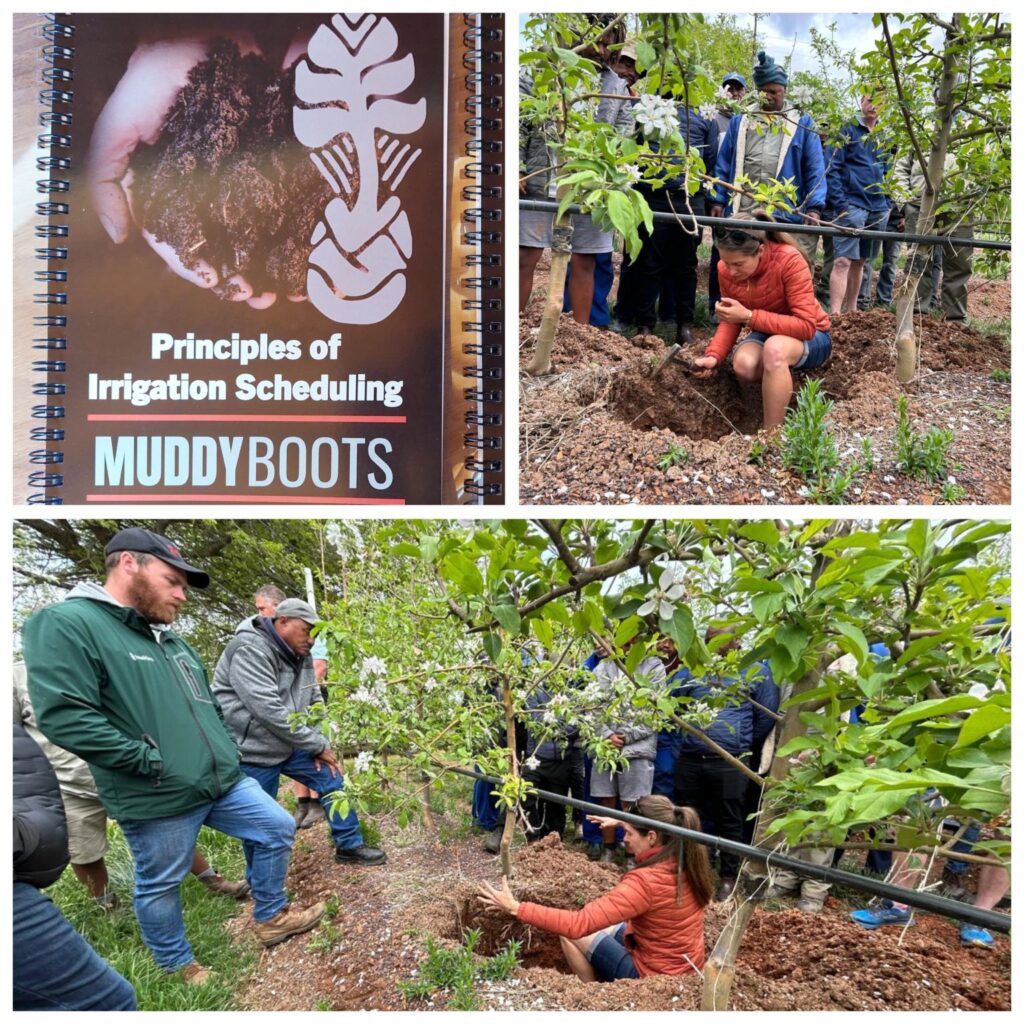
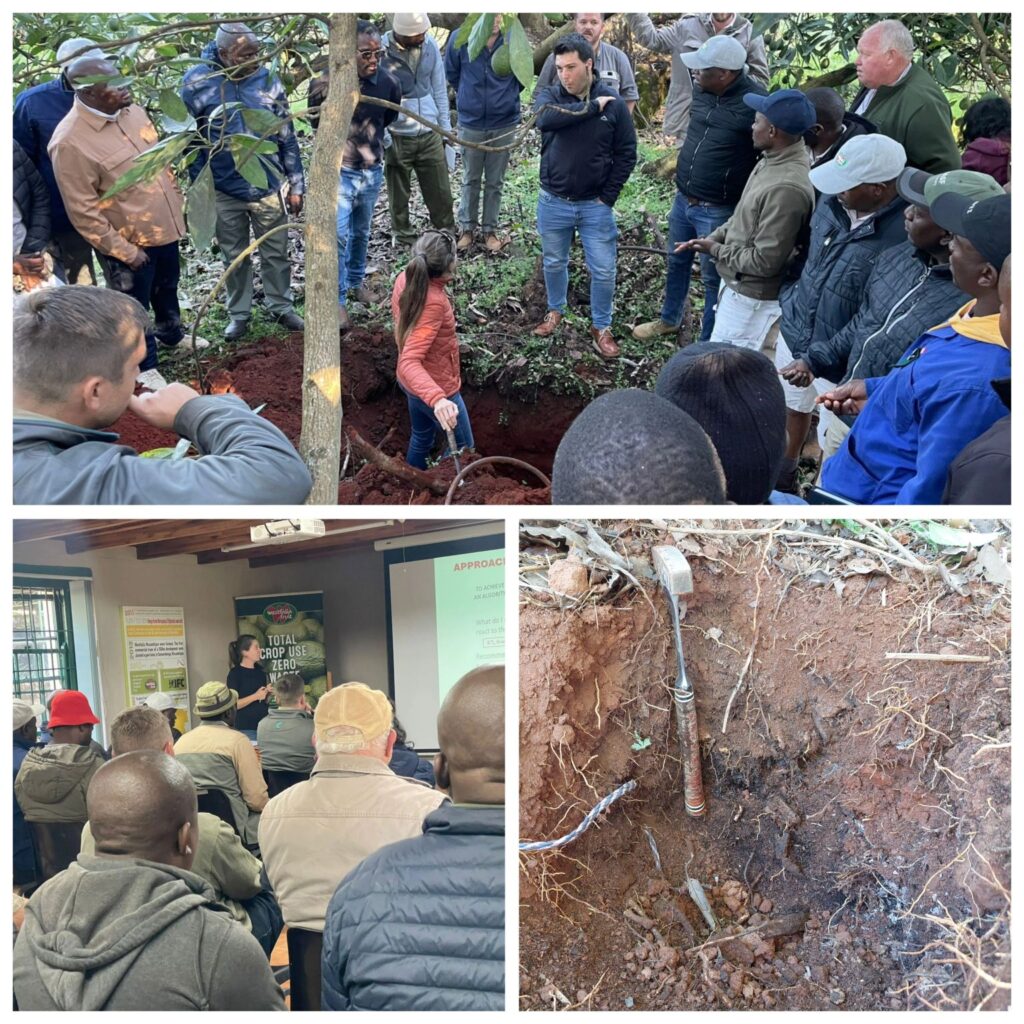
Principles of irrigation scheduling
Irrigation Training Content
- Understanding the interaction between soil, climate and plant physiology for accurate irrigation schedule practices to ensure an optimal water use efficiency : sustainable high crop yield and quality without wasting water.
- How does water leave the Soil and Root zone?
- Evaporation.
- Deep Drainage.
- Runoff.
- Plant water uptake.
- Photosynthesis & Transpiration.
- Causes of stomatal closure.
- Know your root system:
- Practices to improve root development.
- New orchard establishment.
- What is Soil Moisture?
- Soil texture & soil structure.
- Levels of soil moisture.
- Water holding capacity.
- Hydraulic conductivity & irrigation design.
- What is Plant Stress?
- Factors causing plant stress.
- How to monitor plant stress.
- Full irrigation vs RDI.
- Phenological stages, irrigation strategies & allowed extraction %.
- Pome fruit, stone fruit, citrus, table grapes, wine grapes, avocados, others available on request.
- Approaches to irrigation Scheduling:
- Climatological.
- Evapotranspiration & measurement
- Developing & practically using crop factors (Kc).
- Practical calculations.
- Phytomonitoring.
- Understanding the soil water balance.
- Climatological.
- Determining Irrigation Schedules:
- How to split a weekly irrigation requirement to maintain the desire soil moisture.
- Where to apply the irrigation water effectively.
- Accounting for shallow roots, young trees, heatwaves, loadshedding, brak soils, drip, micros and water shortages.
- Monitoring Tools & Valves:
- Weather stations.
- Soil moisture probes.
- Setting upper & lower lines.
- Interpreting probe data.
- Determining an irrigation schedule.
- Physical soil moisture evaluations using a profile hole & auger.
- Interpretation of soil moisture at various depths.
- Phytomonitoring.
- Representative monitoring positions.
- Irrigation systems:
- Objectives for a good irrigation design and system.
- Monitoring and maintaining an irrigation system.
- Is your system delivering what you expect?
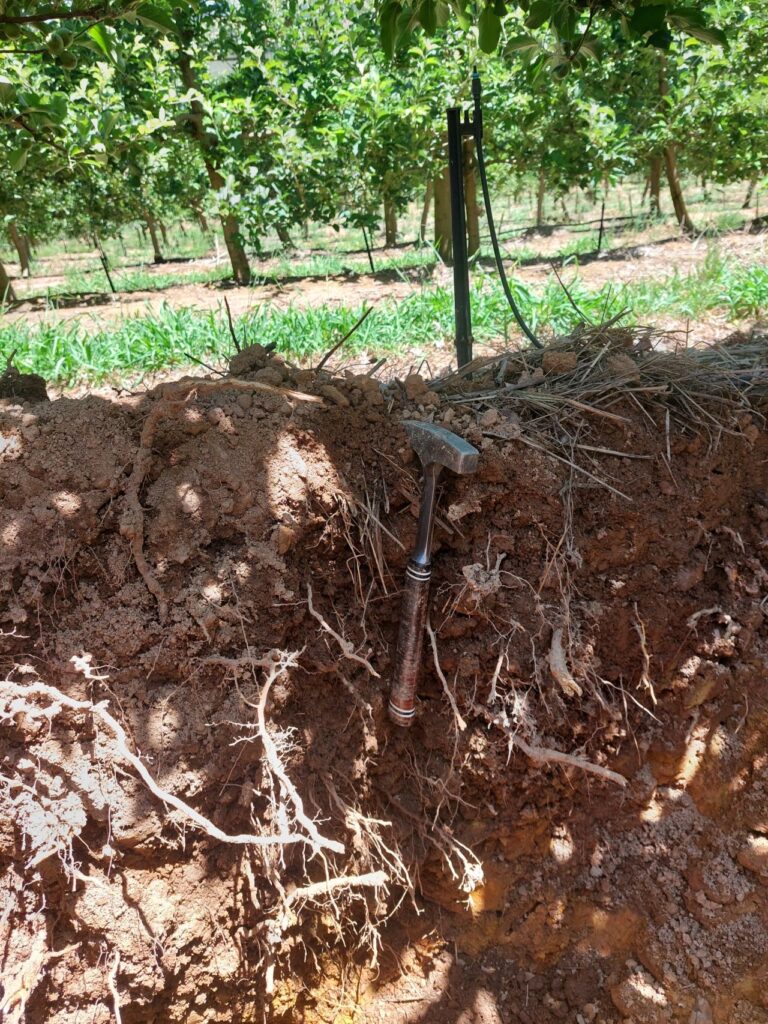
MuddyBoots in an orchard
Irrigation training outcomes
Upskill your farm or clients to take ownership for their data and irrigation related decisions.
- Learn to interpret, validate and take actions using data from soil moisture probes, physical soil moisture evaluations, profile holes and calculations.
- Understand plant physiology, different growth stages and their associated irrigation strategies.
- Implement data collection protocols for record keeping and to aid with informed decision making.
- Develop essential skills and insights required to interpret different soils, irrigation designs, soil moisture and root distribution.
- Plan and execute an effective irrigation schedule at each valve.
- Increase water use efficiency through improved yields and decreased water wastage.
More information?
Contact MuddyBoots for a quote or to discuss your irrigation training needs.